
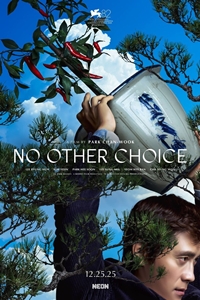
 No Other Choice (R)
Cast: Lee Byung-Hun, Ye-jin Son, Park Hee-Soon, Sung-min Lee
Release Date: December 25, 2025
Runtime: 2 hr. 19 mins.
Genre: Comedy, Thriller
From director Park Chan-wook and based on Donald E. Westlake's novel THE AX, the story follows Man-su on his desperate hunt for a new job after his abrupt layoff from the paper company he served for 25 years.
Watch TrailerReview
Korean director Park Chan-wook has never played it safe, and his tilted sensibilities have sometimes paid off handsomely, whether in the form of the cult classic Oldboy or the Hitchcockian The Handmaiden (which remains Park's best film). His latest, No Other Choice, is a vicious satirical takedown of modern capitalism, where workers are dispensable and the only thing that matters is maximizing profit. Delivered with dashes of black comedy, thriller elements, and pathos, this film illustrates how even a seemingly decent, hard-working man can be driven to unthinkable lengths in pursuit of a job that's to die for... or, more appropriately, to kill for.
The source material is The Ax, a novel written by prolific American novelist Donald Westlake (who, under his Richard Stark pseudonym, created the character of Parker). About 20 years ago, Costa-Gavras adapted the novel; his take on the material was influential for Park's, and No Other Choice is dedicated to the 92-year-old Greek filmmaker. The longevity of the themes speaks to their ongoing relevance in society. They were important when the book was published in 1997, struck a chord when the first film came out in 2005, and remain undeniably potent today.
The movie opens with an idyllic prologue: a sun-dappled slice of wonderland where Yoo Man-su (Lee Byung-hun) lives with his adoring wife, Lee Mi-ri (Son Ye-Jin), and two children. Since this is a Park Chan-wook film, we know all this happiness isn't going to last, and indeed, it doesn't make it past the ten-minute mark. The papermaking company, Solar Paper, where Man-su works, has been purchased by an American rival. Their first action after taking over is to fire many employees... including Man-su. Although devastated, he is convinced he will find a similar job within three months. But, after the passage of a year, he finds himself toiling away in a low-paying retail job. His applications for papermaking positions have all been rejected - he is viewed as a "good" candidate but not a "top" one, and there aren't many available positions for workers with his particular set of skills.
Eventually, Man-su interviews for a job at Moon Paper, but he knows that the odds are stacked against him. He learns that there are two more desirable candidates ahead of him. Consequently, Man-su comes to believe that the only way for him to be offered the job is if the other choices drop out. The surest way for that to happen is if Man-su kills them. As he plots this dark turn of life, he must also cope with the gnawing suspicion that his wife is having an affair with the suave dentist she is working for.
Park shows an almost uncanny ability to switch from tragedy to comedy at the flip of a coin, a tonal tightrope walk that few directors can manage. Lee Byung-hun anchors this madness with a performance of subtle gradations. He doesn't play Man-su as a villain, but as a desperate pragmatist, making his spiral into violence all the more chilling because it feels so logical to him. Some scenes in No Other Choice are deeply moving, grounded by Lee's ability to convey profound exhaustion. Others descend into macabre humor. The first murder comes across rather like a cross between Crime and Punishment and Monty Python. Park avoids the too-obvious trajectory of taking the movie down a path of unallayed comedy, which allows the denouement to pack a punch. I was reminded of Terry Gilliam's Brazil (not the "happily ever after" theatrical release but the darker director's cut).
Park's signature visual panache is on full display here as well. The camera swoops and glides through corridors of corporate sterility and messy crime scenes alike, finding a grotesque beauty in the carnage. As befits the title of the book, Park has an ax to grind about the pernicious influence of globalization on local economies and individuals. Decisions made halfway around the world can result in widespread misery. The pursuit of something as simple as earning a living wage can cause otherwise decent people to act in grotesque ways. Park looks into Man-su's soul and finds the monster lurking there, asking us if we are distinct from him, or just one bad layoff away from joining him.
© 2026 James Berardinelli
Synopsis
From director Park Chan-wook and based on Donald E. Westlake's novel THE AX, the story follows Man-su on his desperate hunt for a new job after his abrupt layoff from the paper company he served for 25 years.