
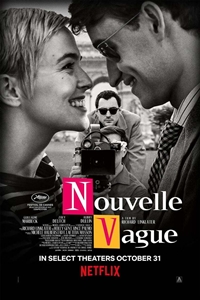
 Nouvelle Vague (R)
Cast: Guillaume Marbeck, Zoey Deutch, Aubry Dullin, Bruno Dreyfurst
Release Date: October 31, 2025
Runtime: 1 hr. 46 mins.
Genre: Biopic, Comedy
A playful, poignant love letter to cinema, this film reimagines the making of Jean-Luc Godard’s Breathless in an exuberant exploration of the youthful rebellion and creative chaos that shaped the French New Wave.
Watch TrailerReview
For Nouvelle Vague, director Richard Linklater offers a three-for-one. It's a hangout movie, a love letter to the French New Wave, and a behind-the-scenes look at one of the era's most famous films: Jean-Luc Godard's Breathless. Stylistically, Nouvelle Vague borrows the cinematic vocabulary of Breathless in both shot selection and presentation. Although created digitally, it employs a boxy 1.37:1 aspect ratio and crisp black-and-white photography. Tonally, it bears more than a passing resemblance to early Woody Allen, with the same kind of gentle cheekiness that pokes fun while also expressing affection.
It perhaps goes without saying that the more one knows about the French New Wave in general and Breathless in particular, the more deeply Nouvelle Vague will resonate. For someone who doesn't know Jean-Luc Godard from Jean-Luc Picard, this may be something of a hard sell. With minimal conflict and a lighthearted (but largely accurate) retelling of the ins-and-outs of New Wave filmmaking, some of the material may still spark interest in the uninitiated, but Linklater clearly assembled Nouvelle Vague with a niche demographic in mind.
The film's first 15 minutes fall squarely within the director's wheelhouse—think Dazed and Confused set within the high-art bubble of Cahiers du Cinéma. Linklater presents a who's-who of the early New Wave, all helpfully identified by captions: Godard (Guillaume Marbeck), François Truffaut (Adrien Rouyard), Claude Chabrol (Antoine Besson), Jacques Rivette (Jonas Marmy), Éric Rohmer (Comé Thieulin), Agnès Varda (Roxane Rivière), Raoul Coutard (Matthieu Penchinat), and Georges de Beauregard (Bruno Dreyfurst). Additional famous faces appear as well - from Jean Cocteau (Jean-Jacques Le Vessier) and Roberto Rossellini (Laurent Mothe) to Breathless actors Jean Seberg (Zoey Deutch) and Jean-Paul Belmondo (Aubry Dullin).
The majority of Nouvelle Vague explores the difficulties, happy accidents, and triumphs encountered by Godard while mounting his debut feature. This includes hiring cast and crew and executing the guerilla-style shoot, with several of Breathless' scenes meticulously recreated. Along the way, although Godard maintains an amicable relationship with his leading man, Belmondo, his dealings with Jean Seberg are considerably pricklier. She chafes at the lack of structure and especially dislikes not having a finished screenplay with lines to memorize. Godard's philosophy - that structure is the enemy of spontaneity and energy - does little to mollify her.
Most of the film's casting magic centers on the three primary actors. Guillaume Marbeck is more than passable as the prickly Godard, and Aubry Dullin is credible as the young, soon-to-be-heartthrob Belmondo. But the real standout is Zoey Deutch, whose Seberg not only looks the part but captures the sassy, sharp-edged attitude the actress was known for during her lamentably short career. Deutch brings color to this black-and-white production.
The French New Wave crested during the late 1950s and early 1960s, and it was during the six-year period between 1958 and 1964 that it was at its most influential. But because so many American directors (including Steven Spielberg and Martin Scorsese) were disciples, it became a touchstone for the next generation of filmmakers - Linklater among them. For him, Nouvelle Vague represents an opportunity to pay homage to an increasingly forgotten era. From the first frame, this is clearly a passion project with limited commercial aspirations. In purchasing the rights, Netflix opted for a limited theatrical run before placing it on streaming - a sensible decision, since it allows those with a passing curiosity to give it a try.
Although I didn't find the film particularly noteworthy, I enjoyed visiting Paris in the late 1950s and appreciated the behind-the-scenes tour. Like many hangout films, it's simply enjoyable to spend time with the characters, even if nothing momentous occurs (depending on one's definition of whether the making of a classic movie qualifies as "momentous"). One thing Nouvelle Vague accomplished, however, was to stoke my interest in revisiting Breathless. And I suspect that reigniting interest in Godard's film may have been Linklater's primary goal in the first place.
© 2025 James Berardinelli
Synopsis
A playful, poignant love letter to cinema, this film reimagines the making of Jean-Luc Godard’s Breathless in an exuberant exploration of the youthful rebellion and creative chaos that shaped the French New Wave.